[an error occurred while processing this directive] [an error occurred while processing this directive] [an error occurred while processing this directive]
[an error occurred while processing this directive]
Research Articles

Reconstructing evolutionary history of Chinese walnuts (Juglans)

Expand
  • 1Key Laboratory of Resource Biology and Biotechnology in Western China, Ministry of Education, College of Life Sciences, Northwest University, Xi′an 710069, China;
    2Xi'an Botanical Garden of Shaanxi Province, Institute of Botany of Shaanxi Province, Xi′an 710061, China;
    3Sustainable Forest Management Research, USDA Forest Service, 201 14th Street SW, Washington, DC, 20250, USA

Received date: 2024-04-02

  Accepted date: 2024-10-18

  Online published: 2024-11-15

Supported by

National Natural Science Foundation of China (32370386 and 32070372), China Postdoctoral Science Foundation (2023MD734225), Science Foundation for Distinguished Young Scholars of Shaanxi Province (2023‐JC‐JQ‐22), Shaanxi Key Research and Development Program (2024NC‐YBXM‐064), Basic Research Project of Shaanxi Academy of Fundamental Science (22JHZ005), the Natural Science Basic Research Program of Shaanxi (2023‐JCQN‐ 0220 and 2024JC‐YBQN‐0212), Science and Technology Program of Shaanxi Academy of Science (2023 K‐49, 2023 K‐26, and 2019 K‐06), Shaanxi Forestry Science and Technology Innovation Key Project (SXLK2023‐02‐20), Qinling Hundred Talents Project of Shaanxi Academy of Science (Y23Z619F17), and the United States Department of Agriculture, Forest Service.

Abstract
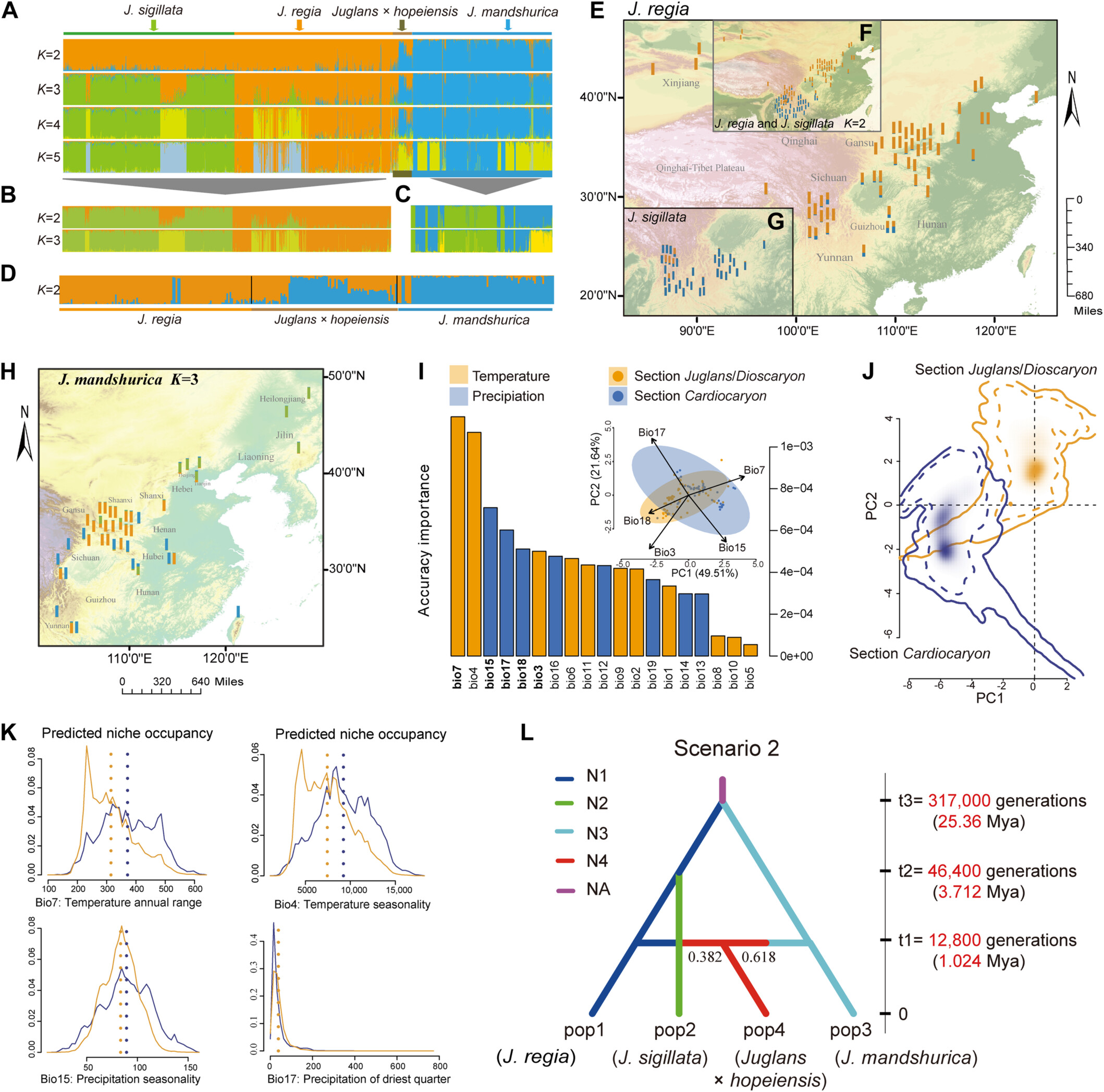
Members of the genus Juglans (walnuts, family Juglandaceae) are typical Tertiary relict tree species. They are widely distributed in China and are well known for their edible nuts and high‐quality wood. The genetic structure and historical gene flow patterns of Chinese Juglans still need to be resolved. Here, we collected samples from a total of 2242 trees from 142 populations of three walnut species (Juglans regia L., Juglans sigillata Dode, and Juglans mandshurica Maxim.) and a hybrid taxon Juglans × hopeiensis. These samples were distributed throughout China. We analyzed population genetic structure, interspecific relationships, lineage differentiation, and speciation using 21 EST‐SSR genetic markers. All populations of J. regia and J. sigillata clustered into one lineage, corresponding to the Juglans sect. Dioscaryon, and all J. mandshurica and Juglans × hopeiensis populations (section Cardiocaryon) clustered into a second lineage. For J. mandshurica, there was an obvious north-south genetic cline. Interestingly, except for seven populations of the hybrid Juglans × hopeiensis, there was almost no gene flow between the populations of section Juglans/Dioscaryon and section Cardiocaryon. A DIYABC analysis showed that J. regia and J. mandshurica differentiated during the Oligocene. Juglans sigillata originated during the Pliocene to the Pleistocene. Subsequently, during the Middle Pleistocene, J. regia and J. mandshurica hybridized within a narrow zone to produce Juglans × hopeiensis. These results demonstrate the impact of repeated turbulent climate changes in the Quaternary on the evolutionary history of Tertiary relict plants.

Cite this article

Meng Dang, Hui‐Juan Zhou, Hang Ye, Shao‐Hong Zhu, Rui Wang, Gui‐Fang Zhao, Keith Woeste, Ming Yue, Xiao Zhang, Peng Zhao . Reconstructing evolutionary history of Chinese walnuts (Juglans)[J]. Journal of Systematics and Evolution, 2025 , 63(3) : 612 -628 . DOI: 10.1111/jse.13153

[an error occurred while processing this directive]
Options
Outlines

/

[an error occurred while processing this directive]